Probing jet base emission of M87* with the 2021 Event Horizon Telescope observations
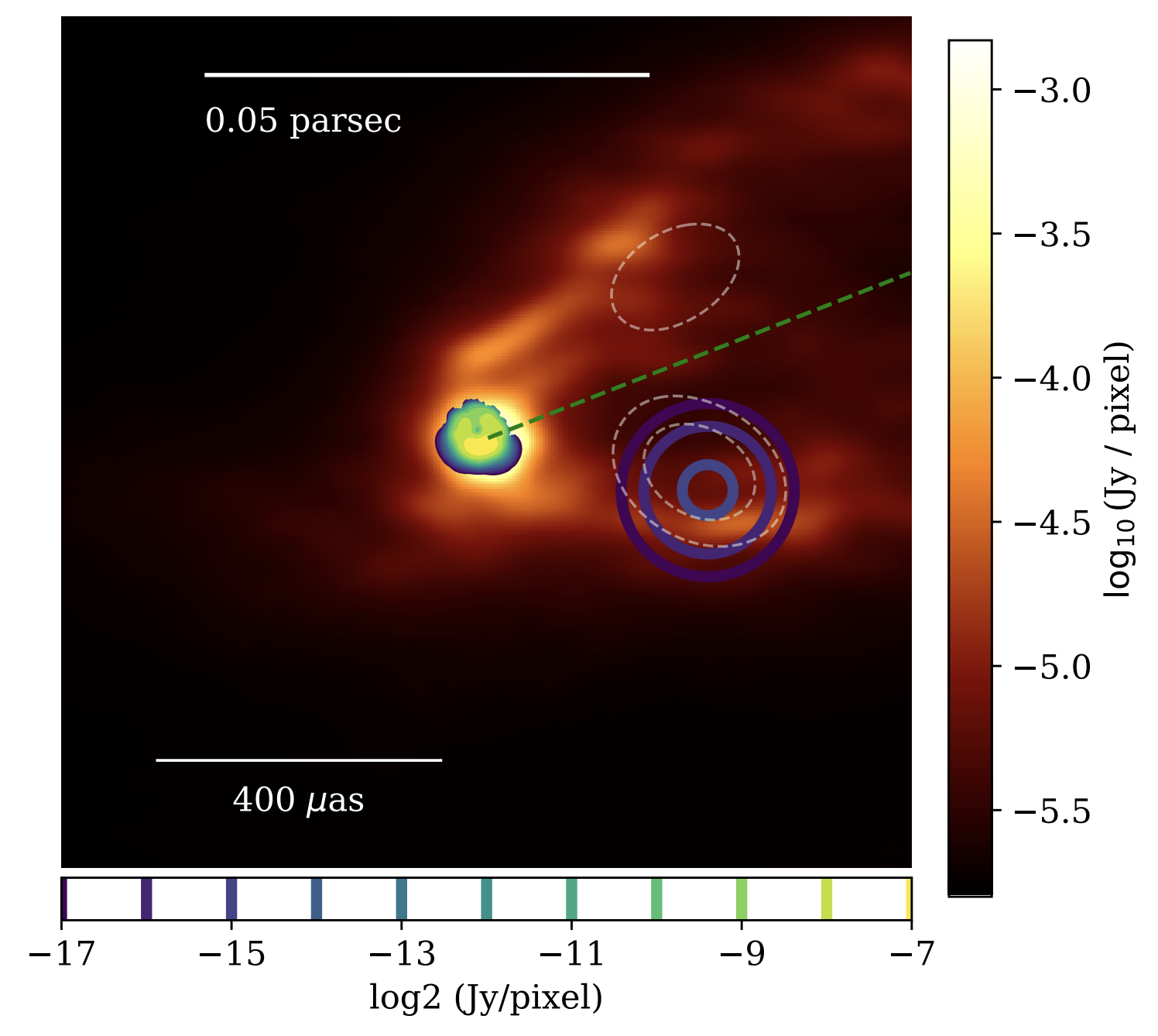
Constraints on the location of the extended emission (contour lines) detected in EHT data, overlaid on EHT M87* images from May 2021 (green heatmap) and lower-frequency M87 images from GMVA (red heatmap). EHT array upgrades began capturing emission information outside the iconic ring. Adapted from Georgiev et al. (2026).
Researchers from the Event Horizon Telescope (EHT) Collaboration developed a new technique to detect and characterize faint, extended emission surrounding M87*, the supermassive black hole whose shadow was first imaged in 2019. By applying this method to EHT observations from 2017, 2018, and 2021, the team found evidence for large-scale emission associated with the black hole’s powerful jet and measured the position of this emission relative to the compact ring seen around the event horizon. The results help bridge the gap between horizon-scale and larger-scale observations of M87*, providing new insights into how black holes launch and sustain relativistic jets.
The paper, Geogiev et al. (2026), was published in the journal Astronomy & Astrophysics. Prof Akiyama and incoming group member Mr Saurabh contributed to this work as members of the EHT Collaboration. See also an accompanying paper led by Mr Saurabh here published just before Prof Akiyama joined Heriot-Watt and launched the research group.