Full-polarization millimeter wavelength variability of Sagittarius A* during the 2018 EHT campaign
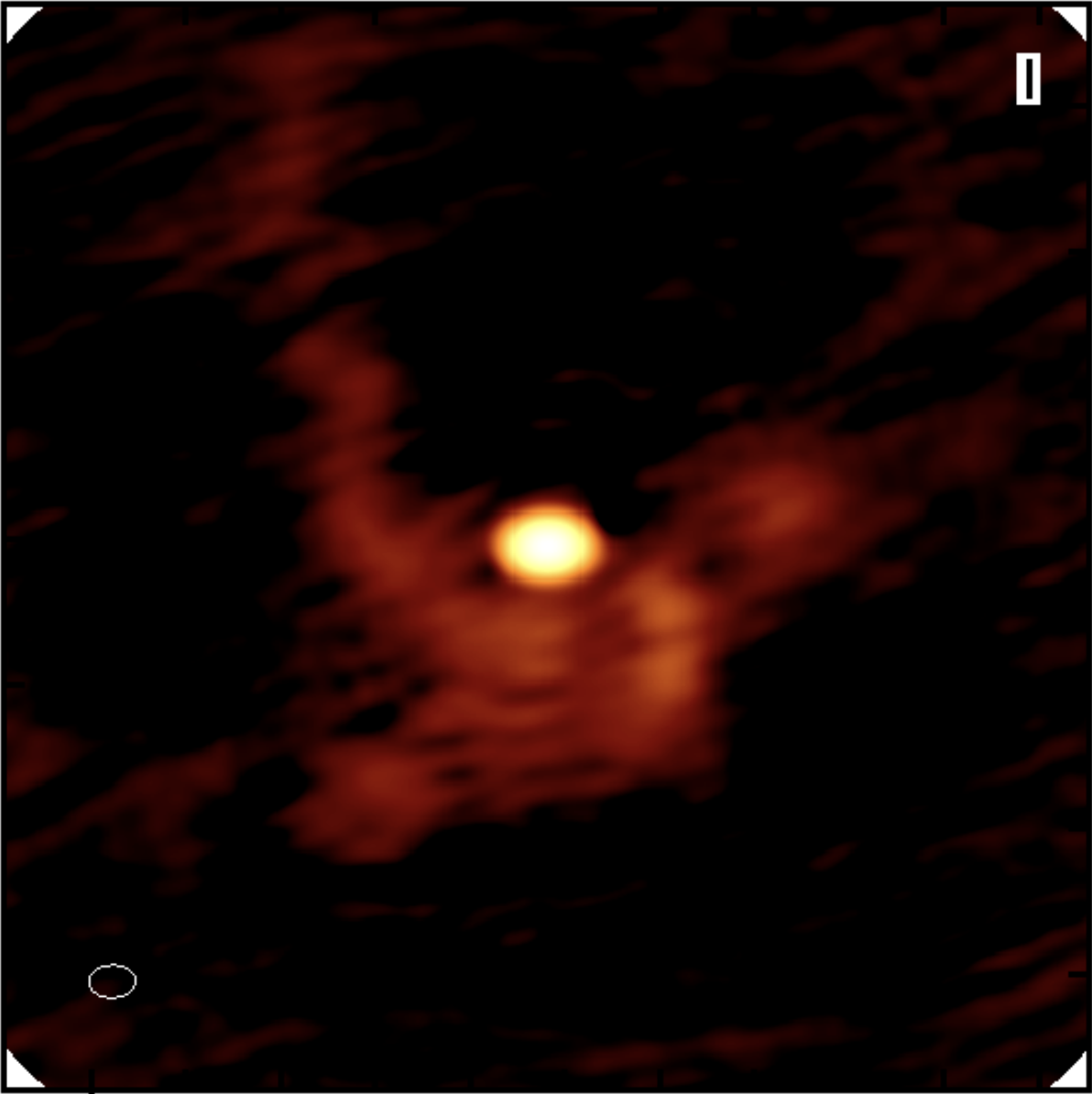
An image of Sgr A* and surrounding mini-spiral arms captured by ALMA during the Event Horizon Telescope (EHT) Observations in 2018. Researchers from the EHT Collaboration captured an usunsual event in which X-ray and millimetre-wave flares appeared nearly simultaneously. Adapted from Albentosa-Ruiz et al. (2026).
Researchers from the Event Horizon Telescope (EHT) Collaboration have carried out one of the most detailed studies to date of the changing behaviour of Sagittarius A* (Sgr A*), the supermassive black hole at the centre of our Milky Way. Using highly sensitive observations from ALMA during the 2018 EHT campaign, the team examined how the black hole’s emission and polarization vary over time. While the overall brightness of Sgr A* was found to be relatively stable, its polarized light exhibited much stronger variability, providing new clues about the magnetic fields and energetic plasma surrounding the black hole. The study also identified an unusual event in which X-ray and millimetre-wave flares appeared nearly simultaneously, challenging some existing models of black hole activity and offering new insights into how matter behaves in the immediate vicinity of an event horizon.
The paper, Albentosa-Ruiz et al. (2026), was published in the journal Astronomy & Astrophysics. Prof Akiyama & incoming group member Mr Saurabh joined this work as members of the EHT Collaboration.