4 K cryocooling for space VLBI with the black hole explorer
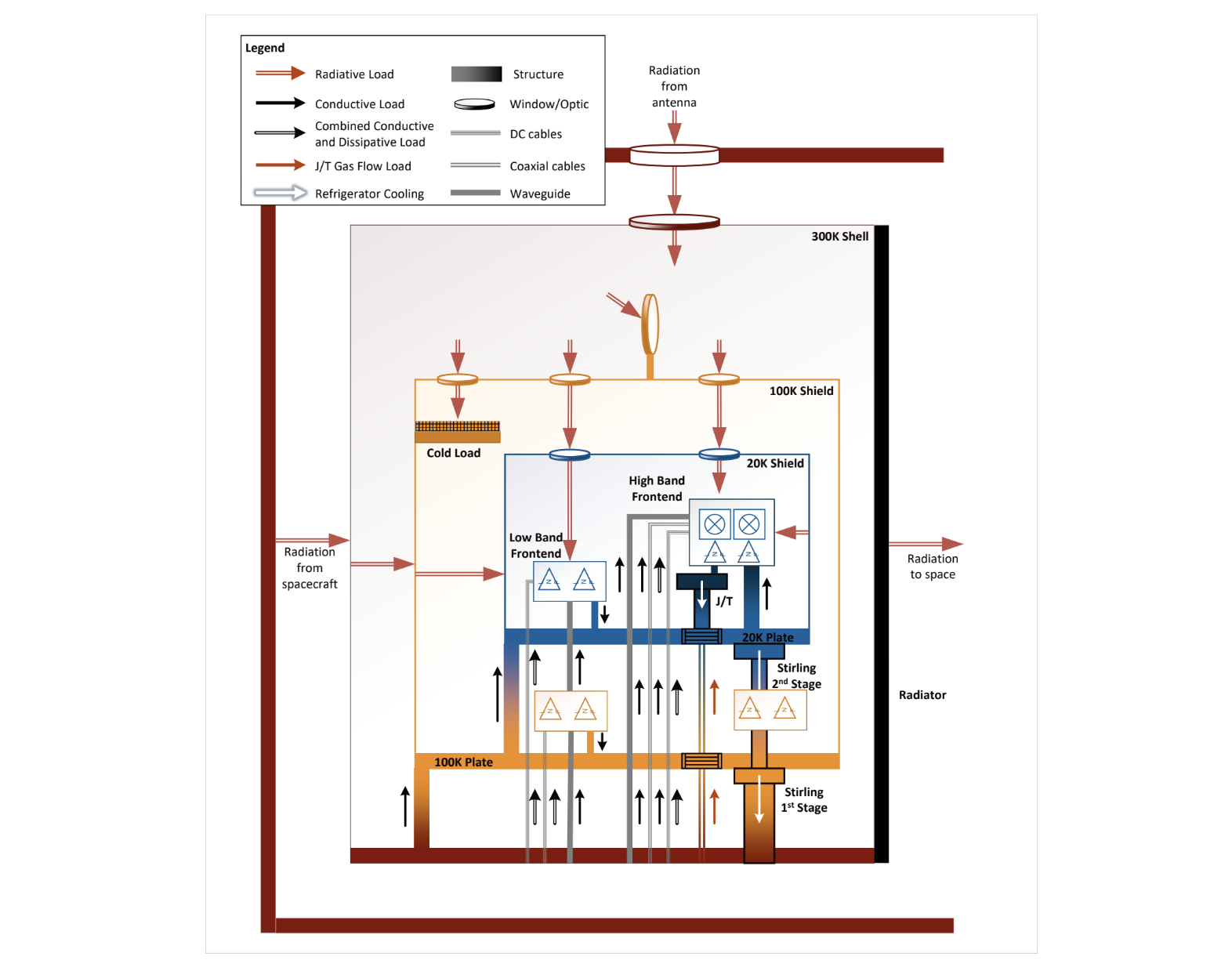
A concept figure of the BHEX Cryocooler adapted from Ranna et al. (2026).
The proposed Black Hole Explorer (BHEX) mission aims to take black hole imaging to an entirely new level by placing part of a telescope array in space, extending the reach of the Event Horizon Telescope far beyond the size of Earth. This would allow astronomers to capture the sharpest images ever made and, for the first time, directly study the elusive “photon ring” - a bright ring of light created by photons orbiting a black hole under the influence of extreme gravity. To achieve this, BHEX requires an exceptionally advanced instrument capable of detecting faint radio signals across a wide range of frequencies. A key challenge is cooling its highly sensitive detectors to temperatures as low as 4.5 degrees above absolute zero, enabling the precision needed for groundbreaking observations. This paper, led by Hanna Rana, outlines the design requirements for the mission’s cryogenic cooling system, a critical technology that will help unlock new tests of Einstein’s theory of gravity and deepen our understanding of some of the most extreme objects in the Universe.
The paper, Ranna et al. (2026), was published in Cryogenics. Prof Akiyama has been a part of BHEX Cryogenic Team, where he takes a role in interfacing the mission team with the Japanese community that has a heritage of space-qualified cryocoolers that satisfy these requirements.