Ring Asymmetry and Spin in M87*
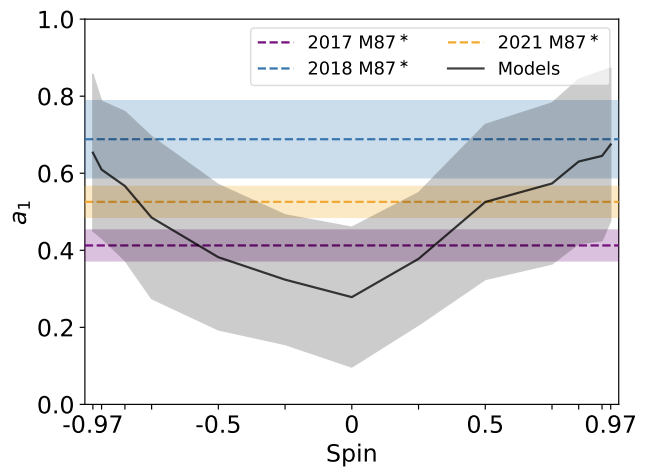
The relation of the black hole spin (horizontal axis) and the degree of the ring brightness asymmetry (vertical axis) measured for a library of general relativistic magnetohydrodynamic (GRMHD) simulations on strongly magnetised accretion flow currently favored for M87* (grayed area). EHT measurements of the ring brightness asymmetry do not prefer a slower (lower) spin value for that simulation library. Adapted from Bernshteyn et al. (2026).
M87*, the supermassive black hole at the centre of the galaxy M87, is known for the bright ring structure revealed by the Event Horizon Telescope (EHT). In this study, researchers investigated how asymmetries in the ring's brightness can be used to constrain one of the black hole's most fundamental properties: its spin. By comparing EHT observations with state-of-the-art simulations of magnetized plasma around black holes, the team found evidence that M87* is unlikely to be spinning very slowly. The results are consistent with theoretical models in which the black hole's spin helps power the spectacular relativistic jet extending thousands of light-years from the galaxy's core, and demonstrate how future EHT observations could provide even tighter constraints on black hole spin.
The paper, Bernshteyn et al. (2026), was published in the journal The Astrophysical Journal. Prof Kazunori Akiyama and the incoming group member Saurabh contributed to this work as members of the EHT Collaboration.