Broadband multiwavelength properties of the archetypal blazar 3C 279 during the 2017 Event Horizon Telescope campaign
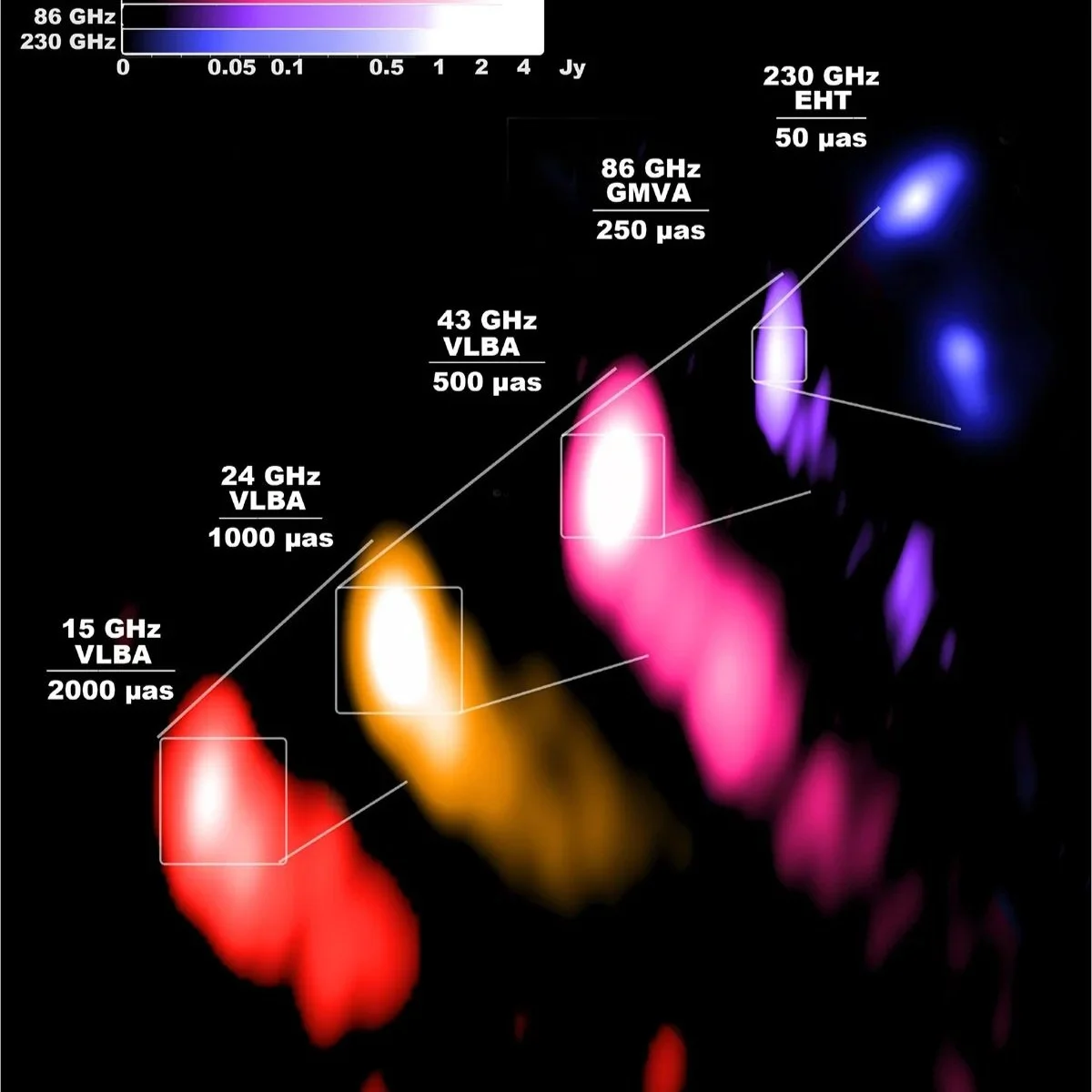
Multifrequency (15, 24, 43, 86, and 230 GHz) composite radio image of 3C 279 obtained in April 2017. This is just only a radio part of an enormous amout of 3C 279 data over the entire electromagnetic specrum presentd in the paper. Adapted from Principe et al. (2026).
The blazar 3C 279 is one of the most variable and energetic sources in the Universe, powered by a supermassive black hole launching a relativistic jet toward Earth. This study combined observations from the Event Horizon Telescope (EHT) with one of the most extensive multiwavelength observing campaigns ever conducted on 3C 279, spanning radio, optical, X-ray, and gamma-ray wavelengths. By tracking changes in the source across the electromagnetic spectrum, the team investigated the physical processes driving its variability and jet activity. The results suggest that much of the observed emission can be explained by turbulent plasma flowing through standing shocks within the jet, while also providing a valuable reference dataset for future studies of black hole jets and high-energy astrophysical phenomena.
The paper, Principe et al. (2026), was accepted for publication in the journal Astronomy & Astrophysics. Prof Akiyama co-led early imaging of EHT 3C 279 data as a co-lead of the EHT Imaging Working Group at that time, and contributed to the calibration and imaging of the EHT 3C 279 data, including imaging with his imaging software SMILI.